Building climate resilience for women and smallholder farmers in Adivasi communities through sustainable beekeeping
- Proposed areas of implementation
- Potential areas of implementation
Project Partner






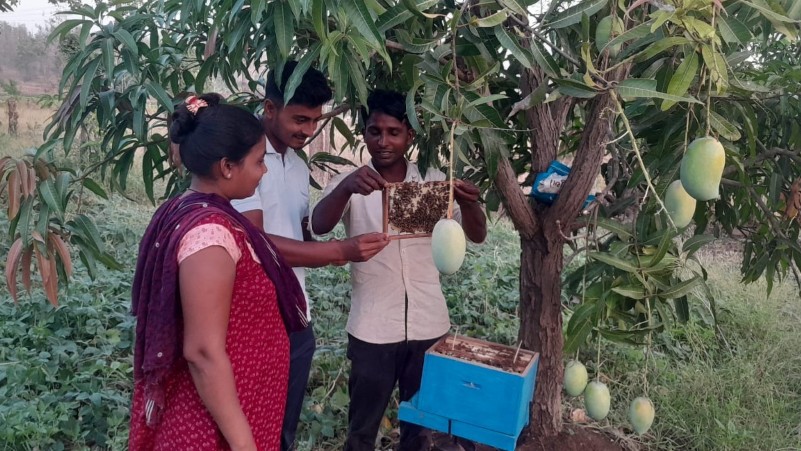
Building on UTMT Society’s proven success in promoting sustainable beekeeping, this initiative is proposed in Chhindwara district of Madhya Pradesh. It aims to address critical challenges such as declining pollinator populations, climate change vulnerabilities, and unsustainable agricultural practices. The project seeks to integrate sustainable beekeeping with indigenous bee species into the agricultural systems of Adivasi smallholder farmers, promoting ecological resilience, and enhancing livelihoods.Over a period of three years, the project aims to directly benefit over 750 Adivasi households, with a focus on including 40% women. Key deliverables include:
- Training and equipping Adivasi farmers in sustainable beekeeping practices,
- Establishing indigenous bee colonies by installing beehives in targeted communities, and
- Developing master trainers to sustain and scale project outcomes.
Context
- Agrarian challenges: Agriculture, primarily rain-fed, is dominated by smallholder, fragmented farms with shrinking average landholdings, limiting productivity and economies of scale. As per the 2011 Census, over 84% of rural households earn less than ₹5000-₹6000 monthly, with nearly 68% falling under the Below Poverty Line (BPL) category. Dependence on monsoon rains for irrigation further restricts cropping intensity and renders farmers vulnerable to erratic rainfall patterns. Degrading soil health, exacerbated by overuse of chemicals and unsustainable farming practices, adds to these challenges, reducing land fertility over time.
- Socio-economic adversities: Chhindwara district has a high prevalence of multi-dimensional poverty. With 56% of the population engaged in casual manual labor, income stability is rare, leading to seasonal migration for survival. Over 36,000 households rely on government schemes like Antyodaya Anna Yojana (AAY) for sustenance, highlighting the depth of poverty in the region. Women in these communities face compounded challenges due to gender inequality, limited access to resources, and socio-economic marginalisation, often shouldering additional burdens during economic downturns.
- Environmental degradation and climate-induced challenges: According to studies, increasing climate variability, with irregular rainfall patterns, rising temperatures, and prolonged droughts, exacerbates water scarcity and threatens agricultural sustainability in the district. Additionally, deforestation and habitat loss have led to biodiversity decline, severely impacting pollinator populations essential for crop productivity.
- Interlinked and compounded vulnerabilities: The compounded effects of declining soil fertility, shrinking farm sizes, water inefficiencies, and diminishing pollinator populations create a precarious situation for Adivasi communities. Marginal farmers, reliant solely on Kharif crops, face seasonal unemployment and are forced into migration. This not only destabilises family dynamics but also limits the region’s socio-economic development.



Problem statement
Goals and objectives
This holistic approach aligns with global Sustainable Development Goals (SDGs) and provides a replicable model for addressing climate-induced adversities while fostering long-term sustainability. By enhancing natural pollination services and integrating sustainable practices, the project seeks to:
- Enhance pollination, food security, and livelihoods: The project employs beekeeping with indigenous bee species as a nature-based solution to bolster pollination, a critical ecosystem service threatened by climate change and biodiversity loss. By fostering pollinator populations, the initiative contributes to improving agricultural yields, thereby mitigating food insecurity exacerbated by erratic rainfall and rising temperatures1. Additionally, the creation of micro-entrepreneurship opportunities through beekeeping and associated activities reduces dependence on monsoon-fed subsistence farming, promoting sustainable livelihoods.
- Strengthen resilience and adaptation for communities: The introduction of beekeeping diversifies income streams for Adivasi households, building economic resilience against climate shocks. Simultaneously, the distribution of bee-friendly flora increases green cover, addressing deforestation. Training farmers in sustainable beekeeping and habitat restoration ensures long-term ecological balance and climate adaptation.
- Address development challenges: Through targeted interventions, the project tackles socio-economic vulnerabilities in tribal communities. It equips marginalised groups, including women, with skills and equipment to secure alternative incomes, reducing migration and improving living standards. Master Trainers, a critical component of the approach, ensure knowledge transfer and scalability of practices within the community.
Approach, methods, and tools
The project employs a structured, participatory approach that includes:
- Capacity building: Training farmers in managing indigenous bees (Apis cerana and stingless species).
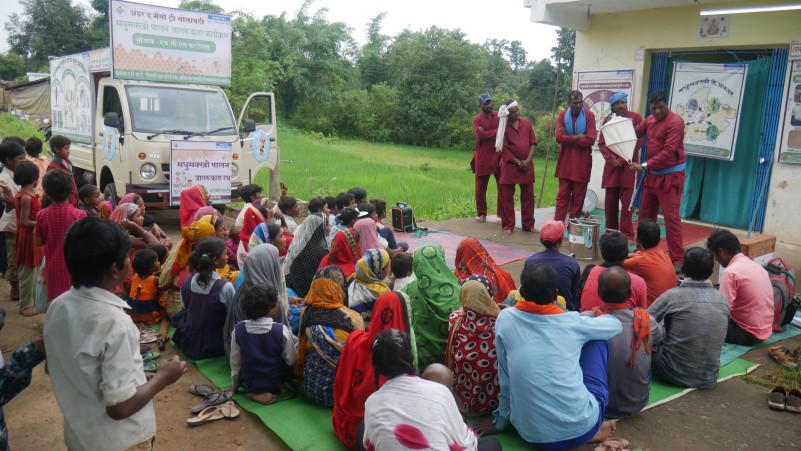
- Community engagement: Conducting awareness programmes to replace harmful honey-hunting practices.
- Resource distribution: Providing starter kits, seeds, and saplings to farmers to create pollinator-friendly environments.
- Monitoring and evaluation: Using baseline and end-line surveys to assess project impact on yields, income, and biodiversity.
Implementation strategy
- Participatory approach
- Engage local communities, and farmers, to foster ownership.
- Conduct awareness meetings in 25 villages to highlight the benefits of beekeeping.
- Capacity building
- Provide hands-on, farm-gate training on sustainable beekeeping using indigenous bee species.
- Offer season-based training sessions for better knowledge retention and adoption/conversion to beekeeper.
- Sustainability measures
- Identify and train Master Trainers (MTs) to provide long-term support and scale the initiative.
- Establish a Beekeeping Resource Centre as a one-stop solution for beekeeping inputs and training.
- Collaborative partnerships
- Collaborate with government agencies, donors, and private sector players for funding, resources, and market access.
- Leverage existing networks like NABARD-supported FPOs for scaling honey production and beekeeping inputs.
- Gender inclusion
- Design training programmes tailored for women, ensuring accessibility, and flexibility.
- Promote women’s participation in beekeeping, leadership roles, and micro-entrepreneurship opportunities.
Proven success and outcomes: RBL Bank Ltd., our corporate donor for over five years, commissioned two external evaluations of the Bees for Poverty Reduction programme—first by RSM International in 2019 and later by SoulAce in 2024. The 2019 assessment revealed that beekeepers earned between Rs 19,000–35,000 annually, with neighbouring plot owners seeing an income rise of Rs 10,000–13,000 per year. The Social Return on Investment (SROI) was exceptionally high, with every Rs 1 invested yielding Rs 8.94 in returns—among the highest for RBL Bank. The 2024 evaluation covered the programme’s implementation across 361 villages in 14 blocks of 7 districts in Gujarat, Maharashtra, and Madhya Pradesh, highlighting strong scaling potential. The project has achieved high ratings: 5 stars for relevance and coherence, 4.5 stars for efficiency, and 4 stars for effectiveness, impact, and sustainability.
About the organisation
As part of our work, we raise awareness about the critical role of local honeybees in agriculture, which helps reduce the widely prevalent unsustainable honey-hunting practices in Adivasi communities. This initiative conserves bee populations across the region, leading to improved pollination not only for food crops but also for forests.
Our innovative model has been recognised with numerous accolades, including a) the Doing Good for Bharat Award for Rural Development (2024), b) in the Environment space, the HCL Foundation Environment Award (2020), and c) the Everest Climate Action Award (2023). Additionally, it has been acknowledged by prominent organisations such as the World Bank (Development Marketplace Award, 2013).
This model has proven to be a vital tool for smallholder communities to build climate resilience while reinforcing the importance of conservation.
 If you are a funder and want to know more about this project,log in or register now with us to get complete access.